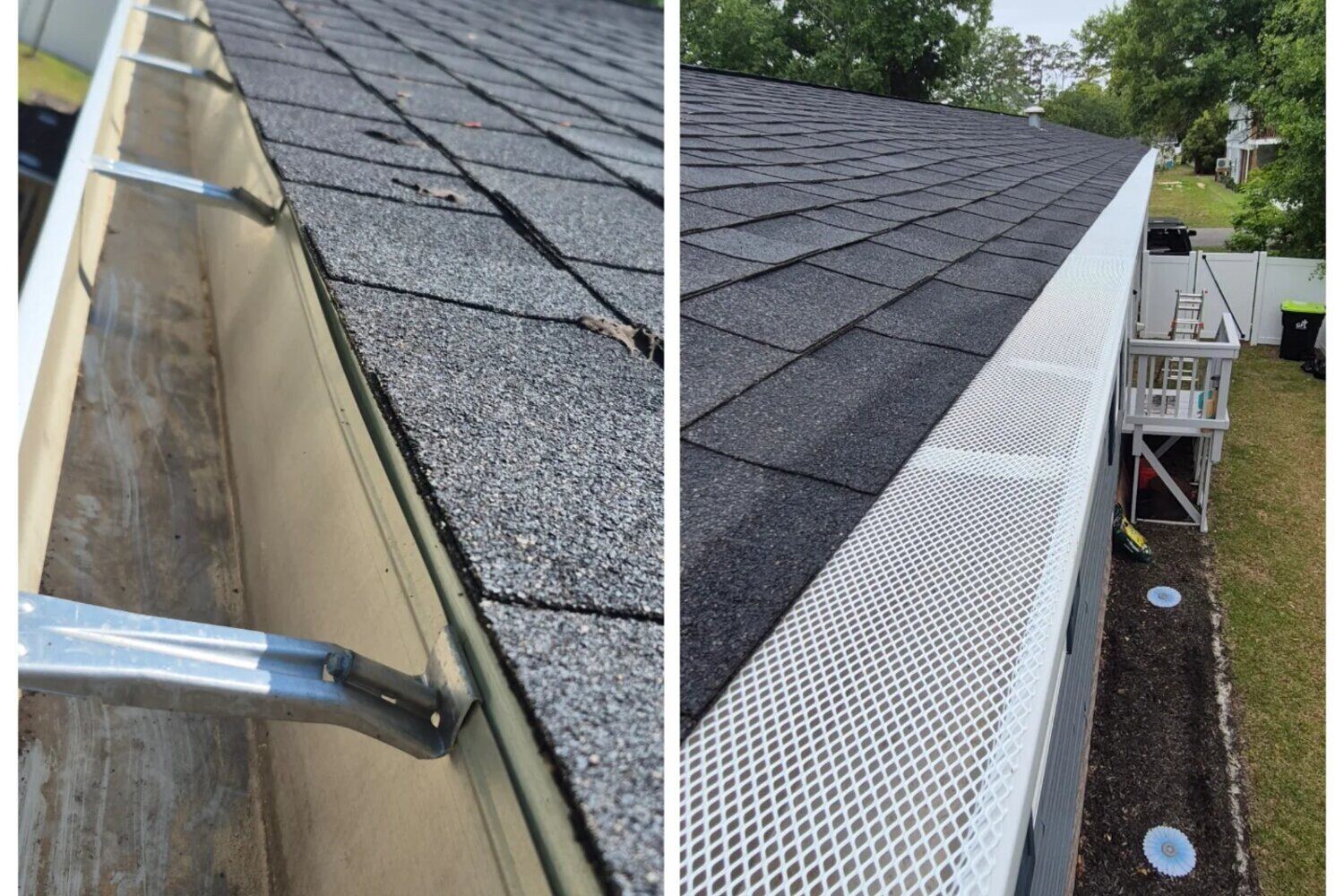
Gutter guards have a credibility problem, and it is deserved. Enough homeowners have bought a product that clogged, overshot or blew off in the first winter that skepticism is the sensible default. But the failures are mostly product failures, not concept failures — and the difference between guard types is enormous.
The Four Types You Will Be Offered
Plastic snap-in screens. The cheapest option, sold in every hardware store. UV exposure makes them brittle within a few seasons, and they pop out under snow load or when a branch lands on them. They also do nothing about fir needles, which slip straight through the mesh.
Foam inserts. A block of foam that fills the trough. Debris sits on top, holds moisture and grows moss — and now you have to pull the foam out to clean underneath it. Avoid.
Reverse-curve helmets. These use surface tension to pull water around a curved nose while debris falls past. They work in moderate rain and overshoot in heavy downpours, which is exactly the weather we get here between November and February. They also let fine needles ride the water into the trough.
Stainless micro-mesh on a rigid frame. A fine woven stainless screen supported by an aluminum frame that fastens to the gutter lip. It blocks needles and grit, handles full-volume rain, and does not go brittle. This is what we install and effectively the only type we recommend for Valley conditions.
Why Oregon Is a Hard Test
Two things make this region tough on guards. The first is conifer debris — fir needles are thin enough to pass through anything but a genuinely fine mesh. The second is rainfall intensity: our storms are long and sustained rather than short and violent, so a guard that handles a quarter-inch an hour is not enough. It has to keep working for hours at a time.
A guard that fails either test will actually make your situation worse, because debris that gets past the screen is now under a cover you have to remove to reach it.
The Honest Cost Comparison
Take a typical Salem home paying for two cleanings a year. Add a third visit if there are firs on the lot. Over ten years that is a meaningful figure — and it buys you nothing permanent. Guards on the same house are a one-time cost with an annual rinse afterwards.
The break-even point lands somewhere between four and six years for most of the homes we quote. If you plan to stay longer than that, the arithmetic favours guards. If you are selling in two years, it probably does not — though a guarded system is a genuine selling point.
What Guards Do Not Fix
Guards do not correct a gutter that is pitched wrong, undersized for the roof, or hanging off failed fasteners. Installing them over those problems just hides them. Any installer worth hiring will fix the pitch and the hangers as part of the job — and if the quote does not mention that, ask why.